Types of Hackers: White Hat, Black Hat, Grey Hat and More
"Hacker" covers very different people, from professionals who are paid to protect systems to criminals who break into them. The usual way to sort them is by two things: whether they have permission, and what their intent is.
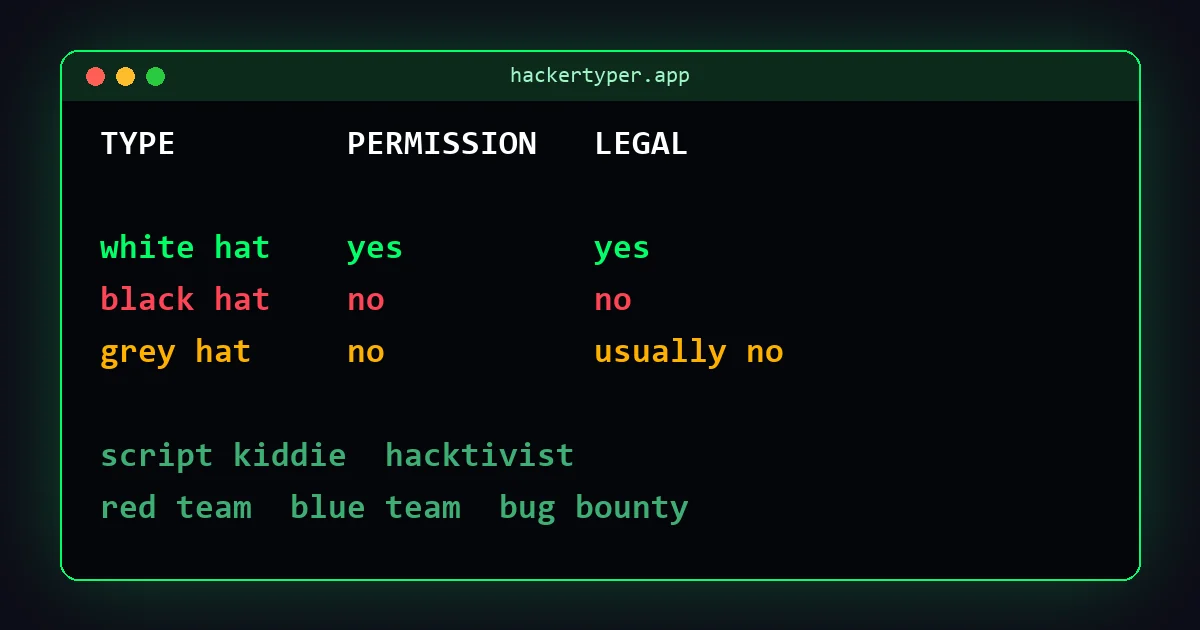
| Type | Permission? | Intent | Legal? |
|---|---|---|---|
| White hat | Yes | Find and fix weaknesses | Yes |
| Black hat | No | Profit, theft or damage | No |
| Grey hat | No | Often well-meaning | Usually no |
Where the word "hacker" comes from
The term began at the Massachusetts Institute of Technology around 1960, where a "hack" meant a clever, playful technical solution. A hacker was someone who enjoyed understanding systems deeply and making them do unexpected things. The criminal meaning arrived later, through news coverage in the 1980s. Many programmers still use the word in its original, positive sense.
The "hat" labels come from old Western films, where heroes wore white hats and villains wore black ones.
The three main types
White hat hackers
White hats, also called ethical hackers, test systems with the owner's written permission. They use the same techniques an attacker would, then report what they found so it can be fixed. They work as penetration testers, security consultants and in-house security staff. This is a normal career with training courses and certifications.
Black hat hackers
Black hats break into systems without permission, for personal gain or to cause harm. Typical activities are stealing data, spreading ransomware that locks files until a payment is made, and committing fraud. This is the criminal hacker of news headlines, and it carries serious penalties in almost every country.
Grey hat hackers
Grey hats sit between the two. A typical grey hat finds a weakness in a system without being asked, does no damage, and tells the owner, sometimes asking for a reward. The intent may be good, but access without permission is still illegal in most places, and good intentions are not a legal defence.
Other types you will hear about
Script kiddies
A dismissive name for people with little skill who use ready-made tools written by others without understanding them. They can still cause real damage.
Hacktivists
People who hack to promote a political or social cause, for example by defacing a website or leaking documents. Whatever the motive, the methods are usually illegal.
State-sponsored hackers
Teams working for governments, carrying out espionage or disruption against other countries and organisations. They are typically well funded and patient.
Insiders
Employees or contractors who misuse access they already have. No break-in is needed, which makes insider incidents hard to detect.
Red teams, blue teams and purple teams
Inside organisations, a red team plays the attacker in a planned exercise, and a blue team defends. When the two work together and share findings, it is called purple teaming. All of them are white hats.
Bug bounty hunters
Independent researchers who look for flaws in products from companies that have published a bug bounty programme, an open invitation with rules and rewards. Because the company has given permission in advance, this is legal as long as the rules are followed.
Other hat colours
You may also see green hat for an eager beginner, blue hat for an outside tester brought in before a product launch, and red hat for someone who goes after criminal hackers aggressively. These labels are informal and used inconsistently.
What separates legal from illegal
One thing: permission. The tools and techniques of a penetration tester and a criminal overlap heavily. What makes the tester's work lawful is a written agreement with the system owner that says what may be tested and when.
How people become ethical hackers
- Learn how computers, networks and the web work, and learn at least one programming language.
- Practise only on systems built for it: capture-the-flag competitions and intentionally vulnerable labs.
- Study for recognised security certifications if you want it as a career.
- Take part in bug bounty programmes, staying strictly inside their rules.
And the hackers in films?
The hooded figure typing at lightning speed is a film invention. Real work is slower and quieter, as we explain in the best hacker movies ranked by realism. If you just want the look, a hacker typer or the hacker simulator gives you that with no skills and no risk; see Is Hacker Typer safe?
FAQ
What are the three main types of hackers?
White hat hackers, who test systems with permission; black hat hackers, who break in illegally for gain or harm; and grey hat hackers, who act without permission but usually without malicious intent.
Is ethical hacking legal?
Yes, when it is done with the explicit permission of the system's owner and within the agreed scope.
Are grey hat hackers breaking the law?
Usually, yes. Accessing a system without authorisation is illegal in most countries even when no harm is intended.
What is a script kiddie?
An unskilled person who uses hacking tools made by others without understanding how they work.