Common Online Scams Right Now and How to Spot Them
Scams are now the crime most of us are most likely to meet, and they arrive in the most ordinary places: a text about a parcel, a call from "your bank", a job offer on social media. Here is what is going around right now, how each trick works, and the simple habits that stop almost all of them.
The numbers
The latest yearly figures from two US agencies show how big the problem has become. Both say the real numbers are higher, because many victims never report.
| Report | What it found |
|---|---|
| FBI Internet Crime Complaint Center, 2025 | 1,008,597 complaints and $20.9 billion in reported losses, up 26% on 2024. Phishing and spoofing were the most reported crime (about 191,000 complaints). Investment scams caused the largest losses ($8.6 billion). People over 60 lost $7.75 billion. |
| Federal Trade Commission, 2025 | 3 million fraud reports and $15.9 billion in losses. Impostor scams were the most reported type. Text messages were the most common way scammers made first contact. |
1. Fake delivery and toll texts
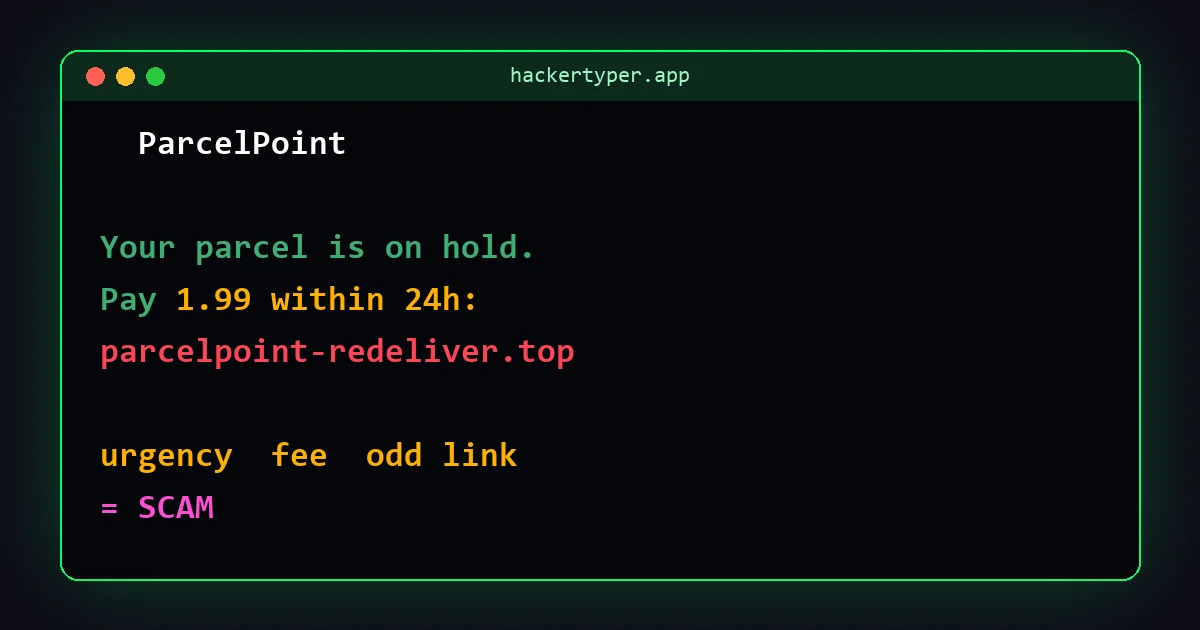
A text says a parcel is on hold or a toll is unpaid, with a small fee and a deadline. The link leads to a convincing payment page that steals your card details. The FTC lists fake delivery problems among the most reported text scams, and fake toll texts drove a sharp rise in reports in 2025.
How to spot it: a fee you didn't expect, urgency, and a link that isn't the company's own website. Check deliveries in the courier's app and tolls on the official toll website you'd normally use.
2. Bank "fraud alerts" and the safe account trick
A text asks whether you made a large payment. Reply "no" and a "fraud team" calls, often with your real details. They say your account is compromised and you must move your money to a new "safe account", or read out a code to "cancel" a payment.
How to spot it: banks never ask you to move money to protect it, and never ask for one-time codes. Hang up and call the number on the back of your card.
3. Phishing links and fake login pages
Emails and messages that look like your streaming service, email provider, IT department or a government agency, asking you to "verify" or "update" details. The page looks right; the address doesn't.
How to spot it: look at the site name in the link (the part just before the first single slash). Better still, never log in from a link: open the app or type the address yourself. Paste anything doubtful into the link checker.
4. Investment and crypto scams
These cause the biggest losses by far. They often start with a wrong-number text, a dating match or a social media "mentor" who shows off profits and invites you to a trading app. Early "profits" look real until you try to withdraw.
How to spot it: guaranteed or very high returns, pressure to invest more, and a platform you can only find through the person who introduced you.
5. "Hi Mum" messages and AI voice clones
A message from a "new number" claiming to be your child, or a phone call in a voice that sounds just like a relative, asking for urgent help with money. Voice cloning now needs only a short recording, and the FBI has warned that AI makes these impersonations harder to spot.
How to spot it: call the person back on the number you already have, or agree a family "safe word" that a scammer wouldn't know.
6. Fake job and task offers
A recruiter offers remote work with high pay for simple tasks like rating products. You earn a little at first, then have to pay in to "unlock" bigger tasks or your earnings. The FBI warns about fake remote jobs that ask for fees, personal information or bank access.
How to spot it: real jobs don't ask you to pay, and real recruiters don't move you straight to WhatsApp or Telegram.
7. Tech support pop-ups
A loud, full-screen warning says your computer is infected and gives a number to call. The "technician" wants remote access to your device and payment. Reported losses to tech support scams reached $2.1 billion in 2025.
How to spot it: real security warnings never show a phone number. Close the tab or the browser; if it won't close, restart the device.
8. Boss and invoice scams at work
An email "from the boss" asks for gift cards, or a "supplier" says their bank details have changed. Business email compromise cost $3 billion in reported losses in 2025.
How to spot it: check any change of payment details by phone, using a number you already have.
The five habits that stop almost every scam
- Pause when you feel rushed. Urgency is the scammer's main tool.
- Don't log in or pay from a link you didn't ask for. Go to the app or website yourself.
- Never share one-time codes, passwords or remote access.
- Check through another channel: the number on your card, the person's real number.
- Turn on two-step verification and use strong, unique passwords.
Where to report a scam
- United States: reportfraud.ftc.gov and, for online crime, ic3.gov.
- United Kingdom: Action Fraud; forward scam texts to 7726 and scam emails to [email protected].
- India: cybercrime.gov.in or the 1930 helpline.
- Australia: Scamwatch. Canada: the Canadian Anti-Fraud Centre.
- Anywhere: if money or card details are involved, call your bank straight away.
Already clicked something? Read what to do if you clicked a phishing link.
Sources: FBI Internet Crime Complaint Center, 2025 Internet Crime Report (April 2026); Federal Trade Commission, testimony to the Joint Economic Committee (March 2026) and Consumer Sentinel data spotlight on text scams (April 2025); FBI public service announcements on fake job offers and AI-enabled impersonation.
FAQ
What is the most common online scam right now?
Phishing, fake messages that trick you into clicking a link or sharing details, is the most reported. Impostor scams, where someone pretends to be a bank, a company, an official or a relative, are the most reported type of fraud overall.
Which scams cost people the most money?
Investment scams, especially fake crypto trading platforms, caused the largest losses in both the FBI and FTC figures for 2025.
Can I get my money back after a scam?
Sometimes, if you act fast. Call your bank immediately; card payments are often easier to dispute than bank transfers, gift cards or crypto.
 Hacker Typer
 Hacker Typer 2.0
 Hacker Simulator
 Fake Hacker Screen
 Hacker Typer Prank
 Fake Update Screen
 Matrix Rain
 White Screen