Spot the Scam
Twenty messages like the ones that land on real phones every day: parcels, bank alerts, job offers, "Hi Mum" texts. Some are scams, some are perfectly normal. Decide which is which, then see the clues that give each one away.
- Free
- No download or sign-up
- Runs in your browser
You scored
All names, numbers and links in the quiz are invented. The tricks are real.
Why this matters
Scams are now the most common crime most people will ever meet. In 2025 the FBI's Internet Crime Complaint Center received over one million complaints reporting $20.9 billion in losses, and phishing was the single most reported type. The US Federal Trade Commission received 3 million fraud reports, and the most common way scammers made first contact was a text message. Read more in common online scams right now.
The clues that give a scam away
- Urgency or threats: "within 24 hours", "your account will be closed", "warrant for your arrest".
- A link or a request you didn't expect, especially to log in, pay or "confirm" details.
- Asking for one-time codes, passwords or remote access to your device.
- Odd payment methods: gift cards, crypto or a bank transfer to a "safe account".
- A new number, a personal email or "I can't talk right now", so you can't check who it really is.
- Too good to be true: prizes you didn't enter, easy money, guaranteed returns.
Not sure about a link? Paste it into the link checker.
Phishing quiz FAQ
What is phishing?
Phishing is a message that pretends to come from someone you trust, such as your bank, a delivery company or a friend, to trick you into clicking a link, sharing details or sending money. Text-message phishing is often called smishing.
Is this quiz suitable for kids and older relatives?
Yes. It needs no sign-up, works on a phone and explains every answer in plain language. It's a good one to do together.
Are the messages in the quiz real?
They are invented, with made-up company names, but each one is modelled on the most common scam types reported by consumer-protection agencies.
What score is good?
18 or more out of 20 is excellent. Missing a couple is normal: the best scams are designed to look exactly like the real thing.
More tools
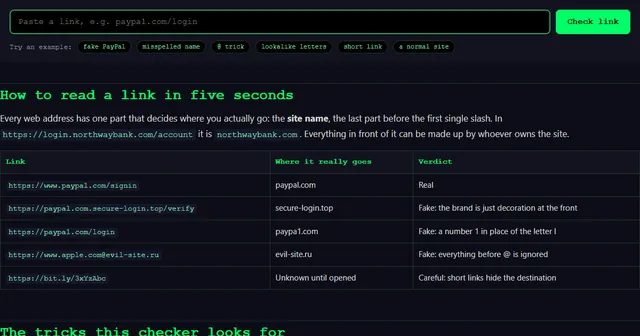 Is This Link Safe?Check a link for phishing tricks before you click.
 Password Strength CheckerHow long would your password take to crack?
 Password GeneratorStrong random passwords, made in your browser.
 Hacker TyperThe classic: mash any key, get lines of kernel code.
 Hacker SimulatorA full fake hacking dashboard with one click.
 Fake Update ScreenWindows, Mac and more: an update that never finishes.
 Matrix RainFalling green code with colour, speed and size controls.
 White ScreenPure white for light, tracing and pixel checks.